Trump Targets Hollywood Production Exodus in Unexpected Political Showdown
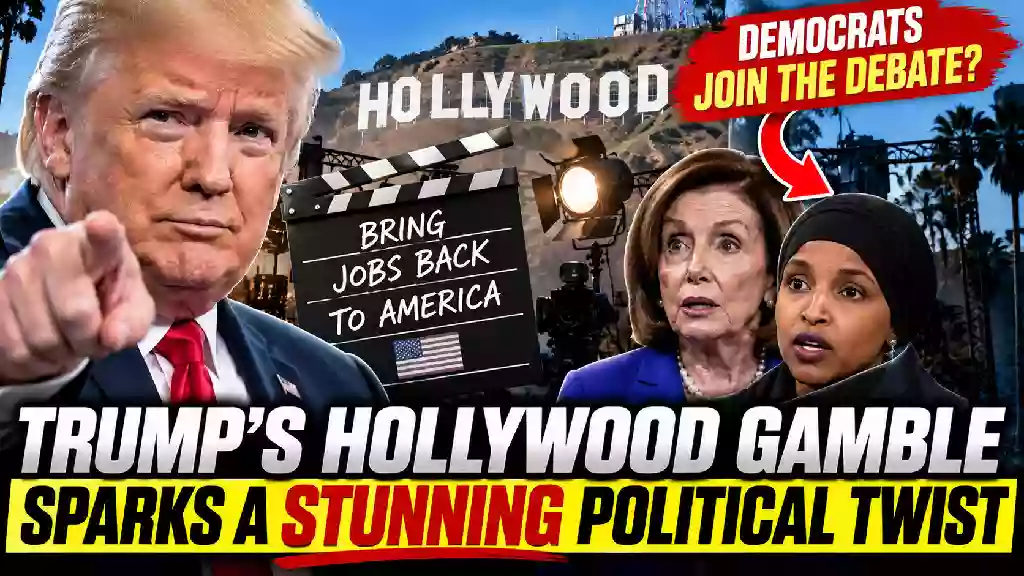
President Donald Trump’s Hollywood plan sparks an unexpected political debate as Democrats enter the discussion over bringing film production and entertainment jobs back to the United States.
Trump Targets Hollywood Production Exodus in Unexpected Political Showdown
Trump Targets Hollywood’s Exodus Triggering an Unexpected Political Showdown
President Donald Trump’s push to bring film and television production back to the United States is creating an unexpected political twist, with the proposal drawing attention from prominent Democrats and fueling a broader debate over the future of Hollywood.
The issue stands out because Hollywood has long been closely associated with Democratic politics, while Trump has frequently clashed with the entertainment industry and many of its most recognizable figures.
Yet the debate over American film production is increasingly shifting toward a question that crosses party lines: How can the United States keep Hollywood jobs and productions from moving overseas?
Trump Targets Hollywood’s Overseas Production Exodus
For years, American film and television productions have increasingly looked outside the United States for locations and financial incentives.
During the discussion featured in the supplied transcript, Caroline Sunshine, a former Trump campaign deputy communications director, argued that foreign jurisdictions have attracted productions by offering more favorable policies and tax incentives.
She pointed to Canada and other international locations as examples of places that have benefited from productions that might otherwise have taken place in the United States.
The argument behind Trump’s proposal is that America needs policies capable of competing with those incentives and encouraging producers to keep more projects on U.S. soil.
Why Hollywood Production Means More Than Movie Stars
The economic stakes extend far beyond actors and directors.
A major movie or television production can employ hundreds of workers, including camera operators, lighting crews, construction workers, transportation specialists, production assistants, makeup artists and other behind-the-scenes professionals.
Sunshine emphasized the size and skill of the American workforce involved in producing movies and television programs. According to the discussion, the concern is not a lack of talent but the growing incentive for productions to take that talent elsewhere.
When productions leave, the economic consequences can reach local businesses and workers that depend on the entertainment industry.
That makes Hollywood production policy an economic issue as much as a cultural or political one.
An Unusual Moment of Potential Bipartisan Agreement
The most politically striking part of the discussion is the suggestion that Trump’s Hollywood initiative could attract interest from across the political spectrum.
The transcript references Adam Schiff, Ilhan Omar and Nancy Pelosi in connection with the broader proposal, describing the issue as one capable of generating unusual agreement between political opponents.
The supplied material does not provide direct statements from Pelosi or Omar formally endorsing Trump’s proposal. Instead, it presents their names in the context of the political discussion surrounding the initiative.
That distinction is important because the broader story is less about a confirmed partisan alliance and more about the possibility that economic interests could create common ground in an otherwise deeply divided political environment.
Hollywood’s Complicated Relationship With Trump
Trump’s relationship with Hollywood has been highly contentious, making the economic proposal even more politically intriguing.
The transcript notes that the entertainment industry has become increasingly hostile toward Trump, while also arguing that his administration could pursue policies designed to strengthen domestic production.
That creates an unusual political contradiction.
Hollywood may remain strongly divided over Trump personally, but people working in the industry could still benefit from policies designed to bring productions and jobs back to the United States.
In other words, political disagreement does not necessarily eliminate the possibility of economic agreement.
The Fight Over Tax Incentives
At the center of the debate is the role of tax incentives.
According to the discussion, foreign governments and jurisdictions have used financial incentives to attract movie and television productions. That competition has contributed to the movement of projects away from traditional American production centers.
The challenge for U.S. policymakers is determining whether similar incentives can successfully encourage producers to remain in America without creating excessive costs for taxpayers.
Supporters are likely to argue that keeping productions domestic can protect jobs, strengthen local economies and preserve America’s position as the world’s leading entertainment brand.
Critics could question whether government incentives are the best solution or whether Hollywood’s changing business model requires a different approach.
Why the Political Twist Matters
The Hollywood debate arrives at a time when partisan divisions dominate American politics.
That makes the prospect of Democrats and Republicans finding common ground over domestic film production particularly notable.
The argument presented in the transcript is ultimately about keeping an American industry—and the jobs surrounding it—in America. The discussion describes Hollywood as an important American brand and argues that productions should not increasingly migrate to places such as Vancouver or Ireland.
Whether Trump’s proposal ultimately succeeds remains an open question.
But the debate has already highlighted a potentially powerful political message: economic policies designed to protect American jobs can sometimes create unexpected alliances, even in industries traditionally associated with one political party.
For Trump, Hollywood could become another front in his broader push to encourage domestic production. For Democrats and entertainment-industry leaders, the proposal could force a difficult question about whether political opposition to Trump should outweigh policies that might benefit American workers.
And that is what makes the Hollywood fight so politically unusual.
#DonaldTrump #Hollywood #HollywoodNews #TrumpNews #AmericanJobs #FilmIndustry #EntertainmentIndustry #NancyPelosi #IlhanOmar #AdamSchiff #USPolitics