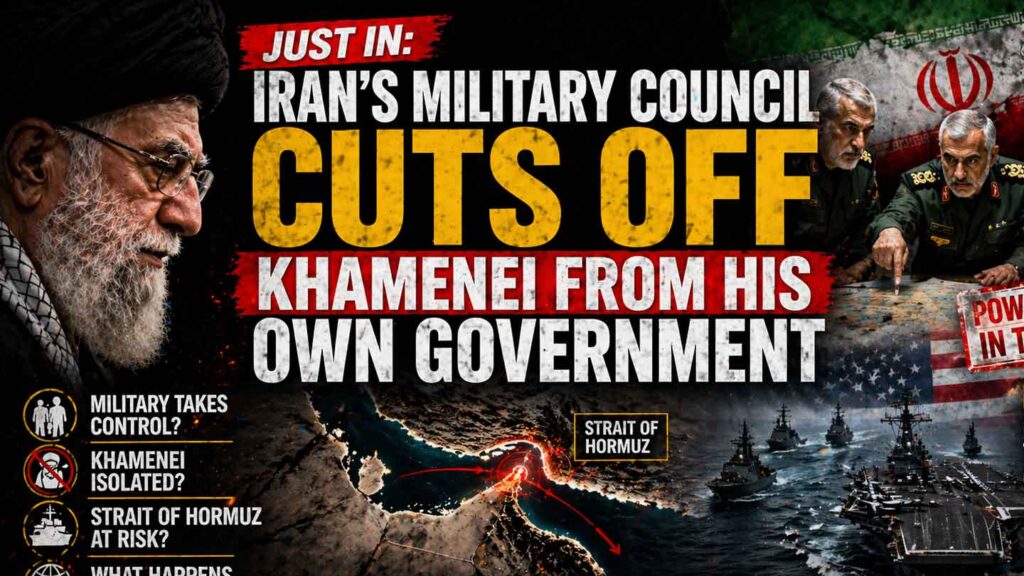
Iran’s military council reportedly cuts off Khamenei from his own government
Irans.jpg
Iran’s military council reportedly cuts off Khamenei from his own government
Introduction: Signs of Instability Inside Iran
Recent reports have raised serious questions about internal dynamics within the Iranian government. Claims that a military council may have distanced or even cut off Ali Khamenei from parts of the state apparatus have sparked intense debate among analysts and policymakers.
While these developments remain unconfirmed, they point to a potential shift in power structures within one of the Middle East’s most influential nations. If true, the implications could extend far beyond Iran’s borders.
Conflicting Signals: A Government Out of Sync
One of the clearest indicators of internal tension is the apparent lack of coordination between key Iranian institutions. Reports suggest that different branches of government have issued contradictory statements on major issues, particularly concerning military and strategic decisions.
For example, conflicting messages about control over the Strait of Hormuz—one of the world’s most critical oil transit routes—highlight possible divisions within the regime.
Such inconsistencies often signal deeper disagreements behind the scenes, raising concerns about cohesion at the highest levels of leadership.
The Military’s Growing Role
The possibility that Iran’s military leadership is exerting increased influence is a significant development. Traditionally, the country’s political system has been heavily centralized under the Supreme Leader.
However, reports indicating that military figures may be acting independently—or even sidelining civilian leadership—suggest a shift in that balance of power.
This raises critical questions: Is this a temporary adjustment during a period of tension, or does it represent a more permanent restructuring of authority within Iran?
Strategic Pressure: External Forces at Play
The reported internal divisions come at a time of heightened external pressure. The United States and its allies have maintained a strong military presence in the region, with naval forces positioned near key strategic waterways.
According to analysts, this pressure may be contributing to instability within Iran’s leadership, as different factions debate how to respond.
Economic sanctions and geopolitical tensions further complicate the situation, potentially intensifying disagreements among policymakers and military leaders.
The Strait of Hormuz: A Flashpoint for Conflict
At the center of the geopolitical tension is the Strait of Hormuz, a narrow but vital shipping route through which a significant portion of the world’s oil supply passes.
Iran has repeatedly suggested it could disrupt traffic through the strait, but analysts question its actual ability to fully control or close it. Reports indicate that while Iran retains some capabilities, such actions would likely provoke a strong international response.
This uncertainty adds another layer of complexity to the situation, as both rhetoric and reality shape global perceptions.
Internal Dysfunction: A Warning Sign?
Experts often view internal dysfunction as a key indicator of potential instability within governments. In Iran’s case, the reported disconnect between political leadership and military command could signal deeper structural issues.
Such divisions may weaken decision-making processes, making it harder for the country to respond effectively to external challenges. At the same time, they could create opportunities for shifts in leadership or policy direction.
Global Implications: Why This Matters
Any instability within Iran has far-reaching consequences. As a major player in Middle Eastern politics, changes in its internal power structure could affect:
- Regional security dynamics
- Global energy markets
- Diplomatic negotiations with Western nations
Uncertainty within Iran’s leadership may also impact ongoing or future negotiations, as different factions pursue competing strategies.
What Comes Next?
At this stage, reports of a military council sidelining the Supreme Leader remain speculative. However, the signals of internal division are difficult to ignore.
Observers will be watching closely for further developments, including shifts in official statements, military actions, or diplomatic engagement. These indicators will provide clearer insight into whether Iran is experiencing a temporary disruption—or a more fundamental transformation.
Conclusion: A Nation at a Crossroads
The possibility of internal conflict within Iran’s leadership highlights the fragile balance of power in a complex political system. Whether these reports prove accurate or not, they underscore a critical reality: stability within major global players cannot be taken for granted.
As tensions continue to evolve, the world will be paying close attention to Iran’s next move.
Read More
Medicare Fraud Crisis: The $60 Billion Problem Threatening U.S. Healthcare